
You are here
Feed aggregator
Wegen Anordnung von Queen Elizabeth II.: Diskussionen um neuen Namen von Andrew Mountbatten Windsor
Nach dem Verlust seiner Titel wurde der ehemalige Prinz nun als Andrew Mountbatten Windsor vorgestellt – ohne Bindestrich. Doch der Buckingham Palast überdenkt die Schreibweise nun, denn sie widerspricht eigentlich einer Anordnung der verstorbenen Queen Elizabeth II.
Categories: Swiss News
«Einwanderungs-Risikogruppe»: Deutschland muss bis Ende 2026 keine weiteren Migranten aufnehmen
Deutschland könnte bis Ende 2026 keine zusätzlichen Migranten aus anderen EU-Staaten aufnehmen müssen, so eine Analyse der EU-Kommission. Der Solidaritätsmechanismus soll Länder mit hohem Migrationsdruck wie Griechenland und Italien entlasten.
Categories: Swiss News
Sécurité nationale : la DGSN coopère avec Interpol pour moderniser ses capacités techniques
Une délégation d’experts de l’Organisation internationale de police criminelle (Interpol) a été reçue, ce mardi 11 novembre, par le directeur général de la Sûreté nationale, […]
L’article Sécurité nationale : la DGSN coopère avec Interpol pour moderniser ses capacités techniques est apparu en premier sur .
Categories: Afrique
The Top Climate Leaders Are Now in The Global South
Belém—30th Conference of the Parties (COP30). Credit: Antônio Scorza/COP30
By Erik Solheim
OSLO, Norway, Nov 11 2025 (IPS)
When world leaders now gather in Belém, Brazil for the UN climate conference, expectations will be modest. Few believe the meeting will produce any breakthroughs. The United States is retreating from climate engagement. Europe is distracted. The UN is struggling to keep relevant in the 21st century.
But step outside the negotiation tents, and a different story unfolds—one of quiet revolutions, technological leaps, and a new geography of leadership. The green transformation of the world is no longer being designed in Western capitals. It is being built, at scale, in the Global South.
Ten years ago, anyone seeking inspiration on climate policy went to Brussels, Berlin or Paris. Today, you go to Beijing, Delhi or Jakarta. The center of gravity has shifted. China and India are now the twin engines of the global green economy, with Brazil, Vietnam and Indonesia closely behind.
Erik Solheim
This is not about rhetoric; it is about results. China accounts for roughly 60 percent of global capacity in solar, wind, and hydropower manufacturing. It dominates in electric vehicles, batteries, and high-speed rail. China’s 93 GW installation of solar in May 2025 is a historic high and exceeds the monthly or short‐term installation levels of any other country to date.
China has made the green transition its biggest business opportunity, turning green action into jobs, prosperity and global leadership. China is now making more money from exporting green technology than America makes from exporting fossil fuels.
India, too, is reshaping what green development looks like. I was in Andhra Pradesh last month, when I visited a wonderful six-gigawatt integrated energy park—solar, wind, and pumped storage. It delivers round-the-clock clean power. There is nothing like that in the West. In another state, Tamil Nadu, an ecotourism circuit is protecting mangroves and marine ecosystems while creating local jobs in tourism. The western state of Gujarat, long a laboratory for industrial innovation, has committed to 100 gigawatts of renewables by 2030, with the captains of Indian business – Adani and Reliance – driving large-scale solar and wind investments with the state government.
These are not pilot projects. They are national strategies. And they are succeeding because the economics have flipped.
The cost of solar power has fallen by over 90 percent in the last decade, largely thanks to the intense competition between Chinese solar companies. Battery storage is now competitive with fossil fuels. What was once an environmental aspiration has become a financial inevitability. In Indian Gujarat, solar-plus-storage projects are already cheaper than coal. Switching to clean energy is no longer a cost—it is a saving.
That is why climate action today is driven not by diplomacy, but by economics. The question is no longer if countries will go green, but who will own the technologies and industries that make it possible.
Europe, long the moral voice of the climate agenda, now risks losing the industrial race. After years of blocking imports from developing countries on grounds of “inferior” green quality, it now complains that Chinese electric vehicles are too good— too cheap and too efficient. Europe cannot have it both ways. The world cannot build a green transition behind protectionist walls. The markets must open to the best technologies, wherever they are made.
President Luiz Inácio Lula da Silva of Brazil understands this new reality. That is why he chose Belém, deep in the Amazon, as the site for climate talks. The location itself is a statement: the future of climate policy lies in protecting the rainforests and empowering the people who live within them.
Forests are not just carbon sinks; they are living economies. When I was Norway’s environment minister, we partnered with Brazil and Indonesia to reward them for reducing deforestation. Later, Guyana joined our effort—a small South American nation where nearly the entire population is of Indian or African origin.
Guyana has since turned conservation into currency. Under its jurisdictional REDD+ programme, the country now sells verified carbon credits through the global aviation market known as CORSIA. In the third quarter of this year, these credits traded at USD 22.55 per tonne of CO₂ equivalent, with around one million credits sold through a procurement event led by IATA and Mercuria.
The proceeds go directly to forest communities—building schools, improving digital access, and funding small enterprises. It is proof that the carbon market can deliver real value when tied to real lives. You cannot protect nature against the will of local people. You can only protect it with them. Last year in Guyana, I watched children play soccer and cricket beneath the jungle canopy—a glimpse of life thriving in harmony with the forest, not at its expense.
That, ultimately, is what Belém should represent: not another round of procedural debates, but a vision for linking markets, nature and livelihoods.
The Global South has also sidestepped one of the West’s greatest political failures: climate denial. In India, there is no major political party—or public figure, cricket star or Bollywood artist—questioning the reality of climate change. Leaders may differ on ideology, but not on this. Across Asia, from China to Indonesia, climate action unites rather than divides. Because here, ecology and economy move together.
Prime Minister Narendra Modi of India puts it simply: by going green, we also go prosperous. President Xi Jinping of China and President Lula of Brazil share that same message—a vision that draws people in, instead of lecturing them. It is this integration of growth and sustainability that explains why the Global South is moving faster than most of the developed world.
None of this means diplomacy is irrelevant. The UN still matters. But its institutions must evolve to reflect the realities of the 21st century. The Security Council, frozen in 1945, still excludes India and Africa from permanent membership. Without reform, multilateralism risks losing its meaning.
Yet, while negotiations stall, transformation continues. From solar parks in Gujarat to high-speed rail across China, from mangrove tourism in Tamil Nadu to carbon markets in Guyana—climate leadership is happening in real economies, not in press releases.
Belém will not deliver a grand agreement. But it doesn’t need to. The world is already moving—faster than our diplomats.
The story of Belem will not be written in communiqués, but in kilowatts, credits, and communities.
The real climate leaders are no longer in Washington or Brussels.
They are in Beijing, Delhi, São Paulo, and Georgetown.
The future of climate action is already here.
It just speaks with a southern accent.
The author is the former Executive Director of the United Nations Environment Programme and Norway’s Minister for Environment and International Development.
IPS UN Bureau
Follow @IPSNewsUNBureau
!function(d,s,id){var js,fjs=d.getElementsByTagName(s)[0],p=/^http:/.test(d.location)?'http':'https';if(!d.getElementById(id)){js=d.createElement(s);js.id=id;js.src=p+'://platform.twitter.com/widgets.js';fjs.parentNode.insertBefore(js,fjs);}}(document, 'script', 'twitter-wjs');
Excerpt:
As climate leaders gather in the Amazon, the world’s green transformation is speaking with a southern accent—powered by markets, technology, and a new economic logic.
Categories: Africa, Europäische Union
«Hoffnung auf den Wunderdoktor»: SCB-Star Loeffel bangte um seine Karriere
Die Folgen einer Hirnerschütterung setzten SCB- und Nati-Verteidiger Romain Loeffel zu. Nach sieben Monaten konnte er sein Comeback geben – und kann nun wieder auf Olympia und die Heim-WM hoffen.
Categories: Swiss News
136/2025 : 11 novembre 2025 - Arrêt de la Cour de justice dans l'affaire C-19/23
Danemark / Parlement et Conseil (Salaires minimaux adéquats)
Politique sociale
La Cour confirme la validité d’une grande partie de la directive relative à des salaires minimaux adéquats dans l’Union européenne
Politique sociale
La Cour confirme la validité d’une grande partie de la directive relative à des salaires minimaux adéquats dans l’Union européenne
Categories: Pályázatok, Union européenne
136/2025 : 11 November 2025 - Judgment of the Court of Justice in Case C-19/23
Denmark v Parliament and Council
Social policy
The Court confirms the validity of a large part of the Directive on adequate minimum wages in the European Union
Social policy
The Court confirms the validity of a large part of the Directive on adequate minimum wages in the European Union
Categories: Balkans Occidentaux, European Union
136/2025 : 2025. november 11. - a Bíróság C-19/23. sz. ügyben hozott ítélete
Dánia kontra Parlament és Tanács
Szociálpolitika
A Bíróság megerősíti az Európai Unióban alkalmazandó megfelelő minimálbérekről szóló irányelv nagy részének érvényességét
Szociálpolitika
A Bíróság megerősíti az Európai Unióban alkalmazandó megfelelő minimálbérekről szóló irányelv nagy részének érvényességét
Categories: Európai Unió : hírek magyarul, Swiss News
Von Kampfjets der Schweizer Luftwaffe begleitet: Maschine der US Air Force über der Schweiz gesichtet – was steckt dahinter?
Eine grosse Militärmaschine der US Air Force flog am Dienstag über die Schweiz. Die Boeing C-40B beherbergt Büros, Schlafgemächer und Kommandozentralen. Das steckt dahinter.
Categories: Swiss News
Le Bénin accueille la représentante du FIDA
Le Fonds International pour le Développement Agricole (FIDA) renouvelle son engagement aux côtés du Bénin.
La représentante du Fonds international pour le développement agricole (FIDA), Mme Claudia Savarese, a présenté ce lundi 10 novembre 2025, ses lettres de cabinet au ministre béninois des Affaires étrangères, Olushegun Adjadi Bakari.
Au cours de cette rencontre, les deux parties ont échangé sur la mise en œuvre des projets soutenus par le FIDA au Bénin.

Mme Savarese a salué les efforts du gouvernement béninois en matière de développement rural et réaffirmé l'engagement de son institution à accompagner les politiques nationales en faveur des populations agricoles.
Le ministre béninois des affaires étrangères a, de son côté, exprimé la reconnaissance du Bénin pour le partenariat fructueux avec le FIDA, dont les interventions contribuent à l'amélioration des conditions de vie dans plusieurs régions du pays.
Cette audience confirme la solidité du partenariat entre le Bénin et le FIDA, centré sur la lutte contre la pauvreté rurale et la promotion d'une agriculture durable.
M. M.
Categories: Afrique
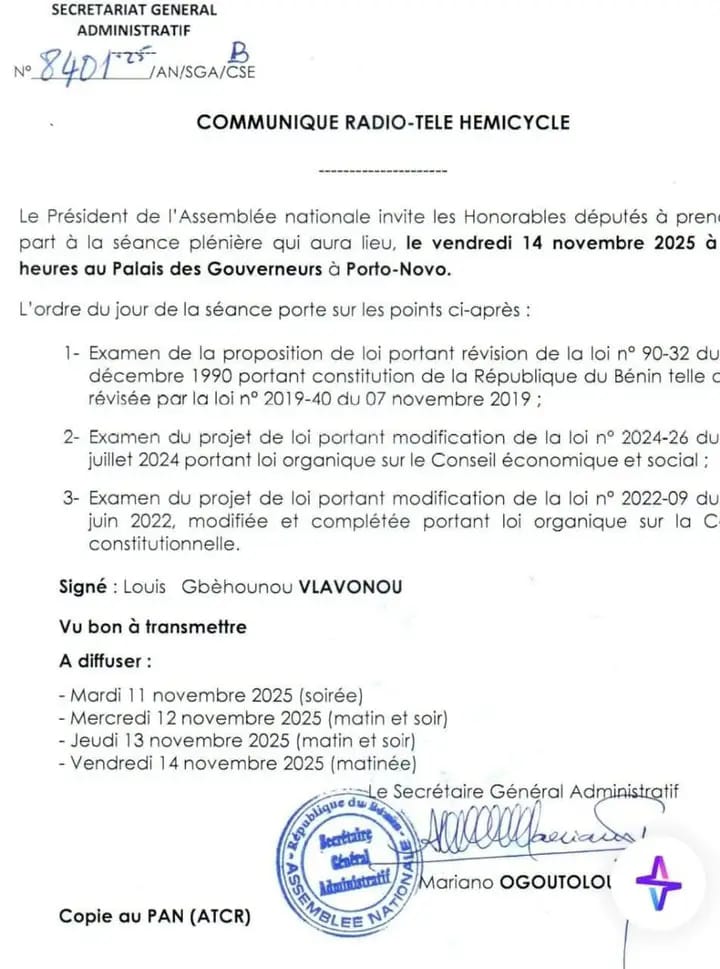
La révision de la Constitution à l'ordre du jour vendredi
Les députés invités à Porto-Novo pour examiner la proposition de révision de la Constitution et deux lois organiques.
L'Assemblée nationale se réunira en séance plénière, vendredi 14 novembre 2025, à 10 heures, au Palais des Gouverneurs à Porto-Novo.
L'annonce a été faite par le Président de l'institution, Louis Gbéhounou Vlavonou, à travers un communiqué.
Trois dossiers d'envergure sont au menu de la session. Le premier point concerne l'examen de la proposition de loi portant révision de la Constitution du 11 décembre 1990, déjà modifiée en 2019.
Les députés auront ensuite à examiner un projet de loi modifiant la loi organique sur le Conseil économique et social (CES), avant de se pencher sur la révision de la loi organique relative à la Cour constitutionnelle, modifiée en 2022.
M. M.
Categories: Afrique
Megkezdődött a „Korai fázisú kutatás-fejlesztési kockázati tőkeprogram című (GINOP Plusz 2.5.1-25) felhívás tervezetének társadalmi egyeztetése
A felhíváshoz kapcsolódó észrevételeket, javaslatokat 2025. november 21. napjáig várják a Partnerség Fórum felületén
Categories: Afrique, Pályázatok
Ce que nous savons du mégaprojet minier de Simandou qui va métamorphoser l'économie de la Guinée
La Guinée est sur le point de devenir une attraction mondiale de part la qualité de son minerai de fer dont l'exploitation commence ce jour. Examinons ensemble ce mégaprojet minier de Simandou.
Categories: Afrique, Swiss News
Ce que nous savons du mégaprojet minier de Simandou qui va métamorphoser l'économie de la Guinée
La Guinée est sur le point de devenir une attraction mondiale de part la qualité de son minerai de fer dont l'exploitation commence ce jour. Examinons ensemble ce mégaprojet minier de Simandou.
Categories: Afrique, Biztonságpolitika
Le nouvel ambassadeur du Ghana près le Bénin reçu à Cotonou
Le ministre béninois des Affaires étrangères, Olushegun Adjadi Bakari, a reçu, lundi 10 novembre 2025, les copies figurées des lettres de créance du nouvel ambassadeur du Ghana près le Bénin, S. E. M. Mohammed Abubakari Manaf.
Nouvelle étape dans la coopération entre Cotonou et Accra. Mohammed Abubakari Manaf, nouvel ambassadeur a présenté, lundi 10 novembre 2025, les copies figurées de créance au ministre béninois des Affaires étrangères, Olushegun Adjadi Bakari.
Les deux personnalités ont échangé sur les moyens de renforcer les liens d'amitié et de partenariat entre les deux pays, notamment dans les domaines économique, sécuritaire et culturel.
Le ministre Adjadi Bakari a salué la qualité des relations bilatérales et exprimé la disponibilité du Bénin à travailler avec le Ghana pour consolider les acquis communs. Le diplomate ghanéen a réaffirmé la volonté de son pays de poursuivre la dynamique de coopération déjà existante entre les deux nations voisines.
M. M.
Categories: Afrique
Im Januar erst eröffnet: Teile von 758-Meter-Brücke in China stürzen ein
Ein Teil der Hongqi-Brücke stürzt ein. Die 758 Meter lange Brücke wurde erst im Januar fertiggestellt und sollte die Provinz Sichuan mit Tibet verbinden. Verletzt wird zum Glück niemand.
Categories: Swiss News
Press release - EU long-term budget: Press conference with lead MEPs on Wednesday at 17:30
Parliament’s rapporteurs on the EU Multiannual Financial Framework (MFF) will brief journalists on their assessment of the negotiations on the 2028-34 long-term budget.
Committee on Budgets
Source : © European Union, 2025 - EP
Committee on Budgets
Source : © European Union, 2025 - EP
Categories: Afrique, European Union
Press release - EU long-term budget: Press conference with lead MEPs on Wednesday at 17:30
Parliament’s rapporteurs on the EU Multiannual Financial Framework (MFF) will brief journalists on their assessment of the negotiations on the 2028-34 long-term budget.
Committee on Budgets
Source : © European Union, 2025 - EP
Committee on Budgets
Source : © European Union, 2025 - EP
Categories: Balkans Occidentaux, European Union
Press release - EU long-term budget: Press conference with lead MEPs on Wednesday at 17:30
Parliament’s rapporteurs on the EU Multiannual Financial Framework (MFF) will brief journalists on their assessment of the negotiations on the 2028-34 long-term budget.
Committee on Budgets
Source : © European Union, 2025 - EP
Committee on Budgets
Source : © European Union, 2025 - EP
Categories: Balkans Occidentaux, Europäische Union
Press release - EU long-term budget: Press conference with lead MEPs on Wednesday at 17:30
Parliament’s rapporteurs on the EU Multiannual Financial Framework (MFF) will brief journalists on their assessment of the negotiations on the 2028-34 long-term budget.
Committee on Budgets
Source : © European Union, 2025 - EP
Committee on Budgets
Source : © European Union, 2025 - EP
Pages
the old site is here


© 2012-2015 Europa Varietas Foundation © 2015-2020 Europa Varietas Association
www.europavarietas.org | info(@)europavarietas(dot)org | Switzerland
This is a GDPR ready site


We are looking for sponsors for the English translation of these books, please contact turkeandras(at)gmail(dot)com