
You are here
Feed aggregator
Media advisory - Employment, Social Policy, Health and Consumer Affairs Council of 1 and 2 December 2025
Main agenda items, approximate timing, public sessions and press opportunities.
Categories: Afrique, Europäische Union
Media advisory - Foreign Affairs Council (Defence) of 1 December 2025
Main agenda items, approximate timing, public sessions and press opportunities.
Categories: Afrique, Europäische Union
Eurogroup presidency: two ministers put forward their candidacies
The election of the new president will take place at the next meeting of the Eurogroup on 11 December. The president is elected by a simple majority of the Eurogroup ministers, in line with the Treaty's Protocol 14 on the Eurogroup.
Categories: Afrique, Európai Unió : hírek magyarul
Weekly schedule of President António Costa
Weekly schedule of President António Costa, 01 – 07 December 2025
Categories: Afrique, Európai Unió : hírek magyarul
Media advisory - Employment, Social Policy, Health and Consumer Affairs Council of 1 and 2 December 2025
Main agenda items, approximate timing, public sessions and press opportunities.
Categories: Afrique, Európai Unió : hírek magyarul
Media advisory - Foreign Affairs Council (Defence) of 1 December 2025
Main agenda items, approximate timing, public sessions and press opportunities.
Categories: Afrique, Európai Unió : hírek magyarul
Felhős szombat – itt-ott köddel vagy gyenge csapadékkal
A Szlovák Hidrometeorológiai Intézet (SHMÚ) előrejelzése szerint enyhén felhős/felhős, szélcsendes időjárás várható szombaton (11. 29.). Az alacsonyabban fekvő vidékeken alacsony szintű rétegfelhőzet vagy köd alakulhat ki. Elszórtan gyenge csapadék is eshet.
What if generative AI is reaching its limits?
Written by David Kemp.
The ability of generative AI (‘GenAI’) to generate plausible text, images, music and computer code in response to human prompts is impressive. GenAI promises huge productivity gains in many domains, and large amounts of financial and political capital are staked on its success. Nevertheless, the current generation of models exhibit well-publicised weaknesses that might not simply disappear by using more data and processing power or smarter training. This paper looks at those limitations, and the lower-profile alternative approaches to AI that could overcome them and even provide the EU with a competitive advantage.
Since the unveiling of ChatGPT in 2022, we have witnessed what many commentators consider to be the most rapid adoption of new technology in recent times in virtually all segments of society. One cannot fail to be impressed by the speed at which it can produce outputs that some say can be ‘PhD-level’.
At the same time, there is growing awareness that these algorithms often produce plausible but demonstrably false outputs (‘hallucinations‘) or outputs that are inconsistent with logic, maths or ‘how the real world works’; they regurgitate problematic biases present in their training data and cannot provide a reliable explanation of how the outputs were derived. ‘GenAI-optimists’ believe that accuracy and tractability will emerge through scaling up the data and processing power available and adding external (human or automated) processes to fine-tune the models. ‘GenAI-pessimists’, on the other hand, point to the fact that finding solutions to the above problems is slowing down, strongly suggesting that the approach is reaching its limits. In addition, the very high energy and resource consumption of the infrastructure necessary for training and running these ‘brute force’, data-driven applications is putting pressure on already stretched supplies. Given the several trillions of private and public capital invested, now and over the next few years, in the geopolitically strategic race for an ‘all-purpose’ artificial general intelligence (AGI), it is worth asking where GenAI’s limits lie and what other approaches might be explored to put Europe at the forefront of AI innovation.
Potential impacts and developmentsGenAI models, in essence, generate a multi-dimensional map of statistical relationships in the training data between ‘tokens‘ – digital representations of linguistic, graphical, musical or other data. The models can then be prompted to produce new combinations of text, images, music, etc. that are consistent with those relationships. In contrast to traditional statistical regression analysis, these models contain billions of parameters and make almost no assumptions about the form of the relationships between tokens. This gives GenAI its enormous advantage in finding the subtle, multivariate patterns that allow it to output plausible text, code, music, images, etc. in response to prompts.
The flip side of this underlying design, however, is that GenAI (like traditional statistical regression) is prone to mistaking ‘noise’ in the training sample for meaningful patterns and producing bizarre results when it is applied to data outside the training set. In addition, pure GenAI trades transparency of ‘reasoning’ for power: a printout of the billion-parameter map of relationships provides no explanation. This is a problem for the required ‘human in the loop’: how can one have confidence in the result if no one knows exactly how it was reached?
Clearly, these design weaknesses limit mission-critical uses of AI. Scaling GenAI does not appear to eliminate these problems, all the while adding additional problems linked to resource usage. Ideally, we would make the most of the powerful pattern detection that GenAI offers, and overcome some of the limitations of a purely data-driven approach. This requires boostingresearch into ‘hybrid’ approaches which, like the human brain, leverage GenAI’s pattern extraction and matching abilities using built-in, explicit models of efficient reasoning strategies and the real world, as well as strategies formaintaining and developingthose models. These approaches provide a reality check to improve the reliability of GenAI’s probabilistic outputs. They are also more efficient (algorithmically and energetically) as they directly encode readily available, fundamental knowledge rather than requiring everything to be extracted by brute force from the data. Finally, the use of explicit representations and strategies allows their reasoning to be inspected.
Neuro-symbolic approaches, such as IBM’s neuro-symbolic concept learner, combine GenAI with explicit rules for symbolic reasoning (for logic, abstraction and generalisation) to enhance reasoning and explainability. Embodied AI – such as Meta’s Habitat – involves training agents in virtual or physical environments where they are designed to learn through perception, action and feedback, promoting causal learning and the development of sensorimotor intelligence. Cognitive architectures, such as Soar, ACT-R and OpenCog, include explicit models of human cognitive processes, integrating perception, memory, learning, planning and reasoning in a modular way. This enables continuity of learning, goal-directed behaviour and long-term memory. World model learning approaches such as DeepMind’s MuZero, Ha & Schmidhuber’s world model agents and DreamerV3 focus on training agents to derive compact, predictive models of their environment to support causal reasoning, generalisation and efficient planning. Finally, it must be underlined that, regardless of the underlying technology, the pursuit of artificial general intelligence is not necessarily the most efficient route to useful applications. Artificial specific intelligence (AI approaches focused on a specific domain, such as the Nobel prize-winning, protein-folding algorithm, AlphaFold2) gives more reliable and transparent results by combining the subtle pattern detection at which GenAI excels with explicitly encoded, domain-specific knowledge.
Anticipatory policymakingThe reliability issues mentioned above call into question GenAI’s ability to deliver the ‘trustworthy and human centric AI … pivotal for economic growth and … [preserve] the fundamental rights and principles that underpin our societies’, as promised in the AI continent action plan. Most AI initiatives from the European Commission have so far concentrated on the implementation of GenAI rather than on research and development of alternative and complementary AI approaches. The €700 million flagship GenAI4EU programme, for example, states its aim as being to ‘integrate generativeArtificial Intelligence (AI) in Europe’s strategic sectors, and keep their competitive edge’. Consequently, most of the calls for projects focus on applying GenAI in particular sectors and providing the data and computing power it needs. The pursuit of artificial general intelligence has attracted an enormous amount of political and economic interest, potentially to the detriment of equally interesting and possibly more efficient and effective alternatives, including those mentioned above.
To best serve the EU’s goals of competitivity and innovation in AI, EU policy and funding could be targeted more directly to support the wholevalue chain of alternative and complementary approaches to GenAI.It is also important to actively further domain-specific AI (artificial specific intelligence)applications alongside GenAI. This can be achieved through proactively promoting such projects for existing funding programmes and by policy guidance in the next multiannual financial framework and the Competitiveness Fund for Digital Leadership.
Read this ‘at a glance’ note on ‘What if generative AI is reaching its limits?‘ in the Think Tank pages of the European Parliament.
Categories: Africa, European Union
Journée de lutte contre le sida: Trois seniors racontent leur vie avec le VIH
Arturo, Max et Renata vivent avec le VIH depuis des décennies. Ils témoignent à l’approche de la Journée mondiale contre le sida.
Categories: European Union, Swiss News
Quand la pierre de souvient : sur les traces de l'antifascisme en Istrie
L'Istrie fut une terre de résistance, où la mémoire des partisans de la Seconde Guerre mondiale reste plus présente qu'ailleurs en Croatie. Pas seulement avec d'imposants monuments brutaliste, mais aussi par des témoignages plus diffus et plus intimes, dans tous les petits villages de la péninsule. Diaporama.
- Articles / Mémoires Italie, Courrier des Balkans, Croatie, Histoire, Yougonostalgie, Une - Diaporama, Une - Diaporama - En premier
Categories: Balkans Occidentaux, Swiss News
Quand la pierre de souvient : sur les traces de l'antifascisme en Istrie
L'Istrie fut une terre de résistance, où la mémoire des partisans de la Seconde Guerre mondiale reste plus présente qu'ailleurs en Croatie. Pas seulement avec d'imposants monuments brutaliste, mais aussi par des témoignages plus diffus et plus intimes, dans tous les petits villages de la péninsule. Diaporama.
- Articles / Mémoires Italie, Courrier des Balkans, Croatie, Histoire, Yougonostalgie, Une - Diaporama
Categories: Balkans Occidentaux, Diplomacy & Defense Think Tank News
Why Spain’s economy isn’t so bueno
Madrid's immigration-fuelled growth has failed to address – and has even exacerbated – a chronic shortage of affordable housing and cost-of-living crisis
Categories: Afrique, European Union
Novo Nordisk warns EU loophole may fuel fake Ozempic trade, pharmacists push back
Drugmakers warn of a 'Wild West' of unauthorised medicines as pharmacists call it a false alarm
Categories: Afrique, European Union
How Trump's pledge to tackle Sudan atrocities could play out
The war is being fuelled by regional powers and the US president may have some leverage over them.
Categories: Africa, Swiss News
How Trump's pledge to tackle Sudan atrocities could play out
The war is being fuelled by regional powers and the US president may have some leverage over them.
Categories: Africa, Határon túli magyar portálok összesített hírei
Exposition | Georges Papazoff : Retrouver Son Chez-soi
Du 30 octobre au 28 novembre 2025, l'Institut culturel bulgare à Paris accueille l'exposition Georges Papazoff "Retrouver son chez-soi" dédiée à l'un des grands noms bulgares de l'avant-garde européenne.
L'exposition présente 22 œuvres originales de Georges Papazoff (1894–1972), peintre bulgaro-français, pionnier du modernisme, toutes issues de la collection privée de Georgi Vassilev, collectionneur et mécène engagé dans la redécouverte de l'artiste. Aux côtés de Papazoff, l'exposition (…)
Categories: Afrique, Balkans Occidentaux
Guinea-Bissau coup was a sham, West African political figures say
Senegal's prime minister and Nigeria's former leader say they do not believe the military takeover was genuine.
Categories: Africa, Határon túli magyar portálok összesített hírei
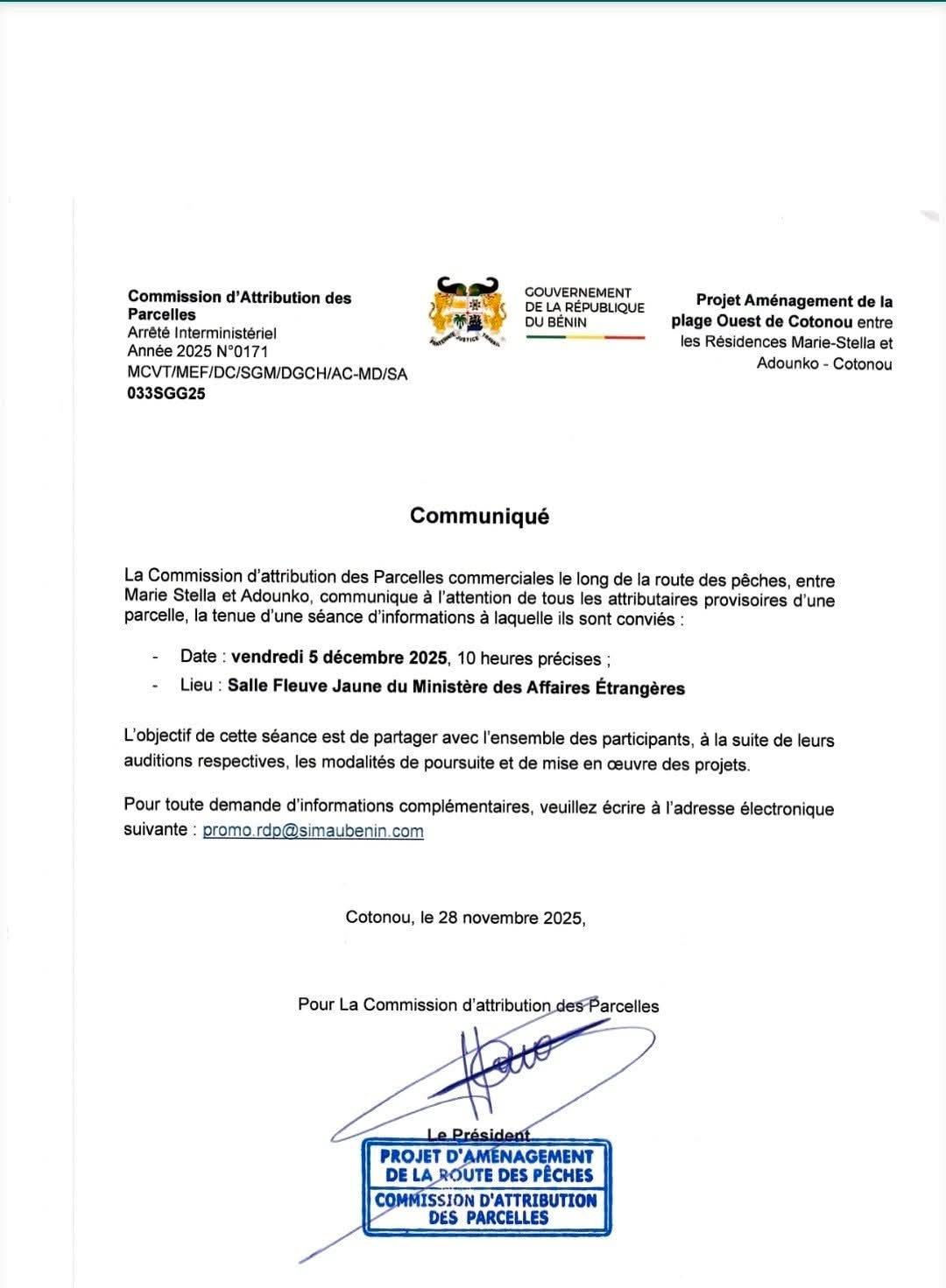
Les attributaires de parcelles de la Route des pêches convoqués
La Commission d'attribution des parcelles situées le long de la Route des pêches convoque les attributaires provisoires pour une séance d'information le 2 décembre.
Une séance d'information est prévue vendredi 5 décembre 2025, à 10 heures, à la Salle Fleuve Jaune du ministère des Affaires étrangères, à Cotonou. Cette rencontre s'inscrit dans le cadre du Projet d'aménagement de la plage Ouest de Cotonou. Elle intervient après les auditions individuelles menées ces dernières semaines.
La Commission veut clarifier plusieurs points. Elle présentera l'état des informations commerciales liées à chaque parcelle. Elle exposera aussi les modalités de poursuite et de mise en œuvre des projets, afin d'harmoniser la suite des démarches.
Categories: Afrique, European Union
08 Nigériens jugés pour transport illégal de devises
Huit (08) ressortissants nigériens, arrêtés le 5 novembre 2025 à la frontière de Hillacondji, ont été présentés devant le parquet spécial près la Cour de Répression des Infractions Économiques et du Terrorisme (CRIET). Ils sont poursuivis pour transport illégal de devises, fraude fiscale et blanchiment de capitaux.
Plus de 94 000 livres sterling, soit plus de 70 millions FCFA, ainsi que 200 000 dollars américains, évalués à plus de 112 millions FCFA, ont été retrouvés sur huit (08) Nigériens. Au total, plus de 180 millions FCFA ont été récupérés par les autorités.
À la barre, les prévenus ont plaidé non coupable. Ils se sont rétractés par rapport à leurs déclarations initiales. Alors qu'ils avaient affirmé pendant l'enquête que les fonds appartenaient à chacun d'eux, ils soutiennent désormais que l'ensemble de l'argent revient au principal accusé, un nommé Issoufou.
Les avocats de la défense ont demandé la mise en liberté de leurs clients. Le ministère public a sollicité un renvoi à huitaine afin de présenter ses réquisitions.
Le juge a fixé la prochaine audience au lundi 8 décembre 2025.
Pour rappel, la réglementation de la BCEAO limite le transport transfrontalier d'espèces à 10 millions FCFA dans l'espace UEMOA. Toute somme égale ou supérieure doit être déclarée aux services douaniers. Ces mesures visent à renforcer la lutte régionale contre le blanchiment de capitaux et le financement du terrorisme.
M. M.
Categories: Afrique, Union européenne
L' ANIP simplifie les mises à jour de documents
L'Agence nationale d'identification des personnes (ANIP) facilite une nouvelle fois les démarches administratives. Les citoyens peuvent désormais corriger eux-mêmes les erreurs constatées sur leurs documents, directement en ligne.
« Pas besoin de vous déplacer ni de faire le rang », pour corriger les erreurs constatées sur les documents délivrés par l'Agence Nationale d'Identification des Personnes (ANIP). Les corrections se font en ligne, assure l'ANIP dans un communiqué.
L'opération se fait via l'application mobile ANIP BJ ou sur la plateforme eservices.anip.bj. Une procédure pensée pour être rapide. « Corrigez vos informations en quelques clics », précise l'agence.
Une fois l'identité confirmée dans l'espace personnel, l'usager doit suivre un parcours simple : sélectionner “Mes données”, puis “Données personnelles”, avant de cliquer sur “Demander des modifications”. Il suffit ensuite de mettre à jour les informations souhaitées et de joindre une preuve, « document témoin ayant servi à l'enrôlement ou décision de justice », indique l'ANIP.
La demande est envoyée d'un clic grâce au bouton “Confirmer et soumettre”.
Selon l'agence, ce dispositif s'inscrit dans une logique de modernisation continue. « L'identité numérique simplifie vos démarches et vous rapproche de vos droits », rappelle le communiqué.
L'ANIP invite par ailleurs les usagers à se rapprocher du service client pour toute question. Le numéro 7054 est gratuit au Bénin. Pour la diaspora, une ligne dédiée est disponible au +229 01 21 40 00 66, ou par mail à serviceclient@anip.bj.
M. M.
Categories: Afrique, Határon túli magyar portálok összesített hírei
Pages
the old site is here


© 2012-2015 Europa Varietas Foundation © 2015-2020 Europa Varietas Association
www.europavarietas.org | info(@)europavarietas(dot)org | Switzerland
This is a GDPR ready site


We are looking for sponsors for the English translation of these books, please contact turkeandras(at)gmail(dot)com