
You are here
Feed aggregator
A Tanács jóváhagyta a műanyag pellet környezetbe jutásának a mikroműanyag-szennyezés csökkentése érdekében történő megelőzéséről szóló rendeletet
A Tanács a mai napon rendeletet fogadott el a műanyag pellet ellátási lánc bármely szakaszában történő környezetbe jutásának megelőzéséről és a mikroműanyag-szennyezés csökkentéséről.
Categories: Afrique, Európai Unió : hírek magyarul
Szexkereskedelemmel vádolnak egy befektetési bankárt
Szexkereskedelemmel és nők kínzásával vádolják Howard Rubin visszavonult amerikai üzletembert, az asszisztensét is letartóztatták.
Rövid ideig élnek a szlovákiaiak, az egészség terén is siralmas a helyzet
Az EU-tagállamok közül Szlovákiában a hatodik legalacsonyabb a születéskor várható élettartam, a svédek és az olaszok 5,5 évvel hosszabb életre számíthatnak, mint országunk lakosai. A születéskor várható egészséges életévek száma szempontjából még siralmasabb a helyzet, a sereghajtók között kullogunk az uniós rangsorban.
Élections législatives en Moldavie : nette victoire des pro-européens
Les Moldaves, plus que jamais partagés entre désir de rejoindre l'Union européenne à marche forcée et volonté d'appartenir au « monde russe », renouvelaient dimanche leur Parlement. Le PAS, pro-européen, arrive nettement en tête.
- Articles / Une - Diaporama - En premier, Politique, Courrier des Balkans, Moldavie Russie UE, Moldavie, Une - Diaporama
Categories: Balkans Occidentaux, Union européenne
Élections législatives en Moldavie : une journée décisive pour l'avenir du pays
Les Moldaves, plus que jamais partagés entre désir de rejoindre l'Union européenne à marche forcée et volonté d'appartenir au « monde russe », renouvellent aujourd'hui leur Parlement.
- Articles / Politique, Gratuit, Courrier des Balkans, Moldavie Russie UE, Moldavie, Une - Diaporama - En premier, Une - Diaporama
Categories: Balkans Occidentaux, Union européenne
Stratégie et cadre régulatoire: «L’idée de transférer UBS aux États-Unis est une option qui a tout son sens»
Un départ de Suisse du siège d’UBS est de plus en plus évoqué. La réputation du pays en matière de gestion de fortune en pâtirait, selon Shelby du Pasquier.
Categories: Central Europe, Swiss News
Assurance maladie 2026: Radios en trop et pilules oubliées coûtent des milliards
Quatre médecins évoquent un examen, un comportement ou une pratique qui engendrent inutilement, et au quotidien, des coûts.
Categories: Central Europe, Swiss News
International Safe Abortion Day
Written by Marie Lecerf.
International Safe Abortion Day, observed annually on 28 September, draws attention to global disparities in access to safe and legal abortion. It also provides an occasion to examine the legal and policy framework within the European Union. While competence in public health lies primarily with the Member States, EU institutions – most notably the European Parliament – have increasingly engaged with sexual and reproductive health and rights (SRHR).
International Safe Abortion DayAbortion remains a global public health issue, with an estimated 73 million induced abortions taking place each year – equivalent to approximately 29 % of all pregnancies worldwide (World Health Organization – WHO). Nearly 45 % of these procedures are considered unsafe, predominantly occurring in countries with restrictive legal frameworks, and contribute to between 4.7 % and 13.2 % of all maternal deaths globally. Conversely, it is reported that, where abortion is legal, most procedures – nearly 90 % in high-income countries – are conducted safely (Guttmacher Institute).
International Safe Abortion Day has emerged as a recognised occasion for raising awareness of these global disparities and advocating for access to safe abortion. First established in 1990 by feminist networks in Latin America and the Caribbean as a regional day of action for the decriminalisation of abortion, it was adopted globally by the Women’s Global Network for Reproductive Rights (WGNRR) in 2011. It is now acknowledged by the WHO and numerous civil society organisations as an opportunity to affirm that access to safe abortion is a component of SRHR. The 28 September 2025 edition addresses the growing international opposition to abortion rights and related human rights movements, such as LGBTQI and feminist advocacy. It highlights the need for collaboration across generations and communities to counter misinformation, legal restrictions, and attacks on those providing or supporting reproductive healthcare.
Access to safe abortion in the European UnionThe EU’s limited legislative competence in public health matters means that abortion remains primarily a national prerogative, governed by Article 168(7) of the Treaty on the Functioning of the European Union and the principle of subsidiarity (Article 5(3) of the Treaty on European Union).
Many Member States have progressively liberalised their abortion legislation, aligning more closely with international health recommendations, including those issued by the WHO and the Council of Europe. Still, some countries maintain restrictive or prohibitive legal regimes.
Legal frameworks across the EU vary significantly. While countries such as Sweden, the Netherlands and Denmark provide abortion on request and have comprehensive reproductive health policies, others –including Malta and Poland – retain more restrictive laws. In Malta, abortion is only allowed in cases where the woman’s life is at risk, and in Poland access is limited to cases involving serious threats to the pregnant woman’s life or pregnancy resulting from sexual violence.
Beyond legal access, many Member States impose additional barriers that hinder timely and equitable access to abortion care. These include mandatory waiting periods, compulsory counselling, gestational limits, and the use of conscientious objection by healthcare providers. Twelve EU countries require a waiting period – ranging from three days (Germany, Hungary, Latvia, Luxembourg, Portugal and Spain) to seven days (Italy) – between the initial request and the procedure. Twelve Member States mandate counselling, which in some cases, such as Hungary and Germany, is framed in prescriptive terms. The majority of Member States also require third-party authorisation for minors, further limiting their reproductive rights.
The use of the conscience clause by medical professionals, while grounded in international protections for freedom of belief, can also severely restrict access to abortion. In Italy, for instance, it is estimated that up to 70 % of healthcare providers invoke conscientious objection, resulting in limited availability of services even where abortion is legal. Similar patterns have been observed in Croatia and Romania. The cumulative effect of these barriers is particularly pronounced for women in marginalised or vulnerable situations, such as those with disabilities, migrants, and young women.
In terms of cost and public coverage, provision also varies. France remains the only EU Member State where abortion is entirely free of charge for all women. Other countries restrict public funding to residents, or limit coverage to medically indicated abortions, excluding on-request procedures. In many Member States, non-resident, undocumented, or migrant women may not be eligible for publicly funded abortion care.
Freedom to choose abortion enshrined in the French constitutionAlmost 50 years after the legalisation of abortion in France, the freedom to choose to have an abortion (‘liberté garantie … d’avoir recours à une interruption volontaire de grossesse’) was officially enshrined in the French constitution on 8 March 2024. Taking the form of a one-line addition to Article 34 (the list of matters upon which Parliament may legislate), the amendment received final approval in the Congrès du Parlement (National Assembly and Senate) on 4 March 2024. President Emmanuel Macron signed the result of the overwhelming 780-72 vote in favour (which received a standing ovation) on 8 March (International Women’s Day). This amendment to the 1958 constitution designates a ‘guaranteed freedom’ to choose to terminate a pregnancy.
Since its legalisation in 1975 through a law supported by then Minister for Health Simone Veil (later the European Parliament’s first female president, and the first president of the directly elected Parliament), the right to choose to terminate a pregnancy has consistently gathered support from the political community, civil society and public opinion in France. The law has been updated nine times – on each occasion with the aim of extending access to abortion. The right to choose abortion has evolved from a public health measure, which motivated its decriminalisation, to a fundamental right. France is the first country in the world to make access to abortion an explicit constitutional right. Similar initiatives have been considered in other Member States, such as Sweden, while Member States such as Spain have reformed the law to improve access to safe and legal abortion.
European Parliament positionDuring the ninth legislative term, the European Parliament has consistently advocated the decriminalisation of abortion and the removal of legal, financial, social and practical barriers to access. In various resolutions adopted between 2021 and 2024, Parliament called for the inclusion of abortion rights in the EU Charter of Fundamental Rights, and condemned restrictive measures in EU Member States, such as Poland, and in the US. On 11 April 2024, Parliament adopted a resolution on including the right to choose an abortion in the EU Charter of Fundamental Rights. The resolution affirmed that access to SRHR, including safe and legal abortion, is a fundamental right. Parliament called on the European Council to revise the Treaties to include these rights in the EU Charter. It urged Member States to fully decriminalise abortion in line with WHO guidelines and to remove legal and practical barriers, specifically calling on Poland and Malta to repeal restrictive laws. MEPs also condemned the denial of abortion based on the conscience clause, especially when it endangers patients’ health or lives.
Read the complete briefing on ‘International Safe Abortion Day‘ in the Think Tank pages of the European Parliament.
Categories: Balkans Occidentaux, European Union
Magazine De La Culture
Les échos de la vitalité de la culture africaine et de sa diaspora avec Valérie Bony.
Categories: Afrique
Czech president to steer post-election course as populists lead
With ANO leading the polls and coalition talks set to be messy, Pavel’s red lines could shape who governs Czechia
Categories: Afrique, European Union
Fragmentation is holding back Europe’s defence drive
Europe's record defence spendings risk being squandered unless fragmentation gives way to standartisation
Categories: Afrique, European Union
Zimbabwe is tobacco country. But some think the future lies in blueberries
"The future is food, not a bad habit," horticulture specialist Clarence Mwale tells the BBC.
Zimbabwe is tobacco country. But some think the future lies in blueberries
"The future is food, not a bad habit," horticulture specialist Clarence Mwale tells the BBC.
Categories: Africa, Central Europe
Zimbabwe is tobacco country. But some think the future lies in blueberries
"The future is food, not a bad habit," horticulture specialist Clarence Mwale tells the BBC.
Categories: Africa, Swiss News
Bal de rentrée
Categories: Balkans Occidentaux, Europäische Union
Inauguration de l'Académie de Police à Cotonou
Le Ministre de l'Intérieur et de la Sécurité Publique, Alassane Seidou a procédé, jeudi 25 septembre 2025, à l'inauguration de l'Académie de Police au sein de la base de l'ex Compagnie Républicaine de Sécurité (CRS) à Cotonou. La cérémonie a eu lieu en présence de Brian Shukan, Ambassadeur des Etats-Unis près le Bénin.
La base de l'ex Compagnie Républicaine de Sécurité (CRS) abrite désormais l'Académie de Police. Elle a été inaugurée ce jeudi. L'Ambassade des Etats-Unis près le Bénin a fait don d'un important lot de matériels au profit des unités de la Police Républicaine. D'une valeur total d'un million de dollars américains, ce don est constitué entre autres d'équipements de protection individuelle, d'uniformes, de paires de bottes, des jumelles, des miroirs de fouille, des sacs médicaux contenant des consommables complets d'urgence médicale et de divers autres équipements.
Le Ministre Alassane Seidou s'est réjoui de l'état des relations entre le Bénin et les Etats-Unis. « L'engagement du Bénin demeure ferme dans l'approfondissement et la diversification de sa coopération avec les Etats-Unis d'Amérique dans le domaine de la sécurité. Le Gouvernement du Bénin réaffirme sa volonté de continuer à œuvrer pour le renforcement des capacités opérationnelles de la Police républicaine et la synergie nécessaire avec tous ses partenaires internationaux pour faire face efficacement aux défis sécuritaires... », a déclaré le Ministre de l'intérieur et de la sécurité publique.
L' Ambassadeur des Etats-Unis près le Bénin a réaffirmé l'engagement de son pays à soutenir le Bénin sur le plan sécuritaire.
A.A.A
Categories: Afrique, Central Europe
Le Bénin se dote d'un robot de déminage
Au Bénin, les Forces de défense et de sécurité (FDS), viennent d'être dotées d'un outil important de lutte contre le terrorisme. Il s'agit de robot de déminage, mis à la disposition du Centre de perfectionnement aux actions post-conflictuelles de déminage et de dépollution (CPADD), le jeudi 25 septembre 2025 à Ouidah, dans le département de l'Atlantique.
Le Bénin franchit un nouveau cap dans le cadre de la lutte contre le terrorisme, avec l'acquisition de robot de déminage mis à la disposition du Centre de perfectionnement aux actions post-conflictuelles de déminage et de dépollution. C'était à l'occasion d'une cérémonie co-présidée par le Chef d'Etat-Major des Forces Armées Béninoises, l'Ambassadeur du Royaume des Pays Bas près le Benin, et le premier secrétaire, représentante de l'Ambassadeur de l'Allemagne au Benin.
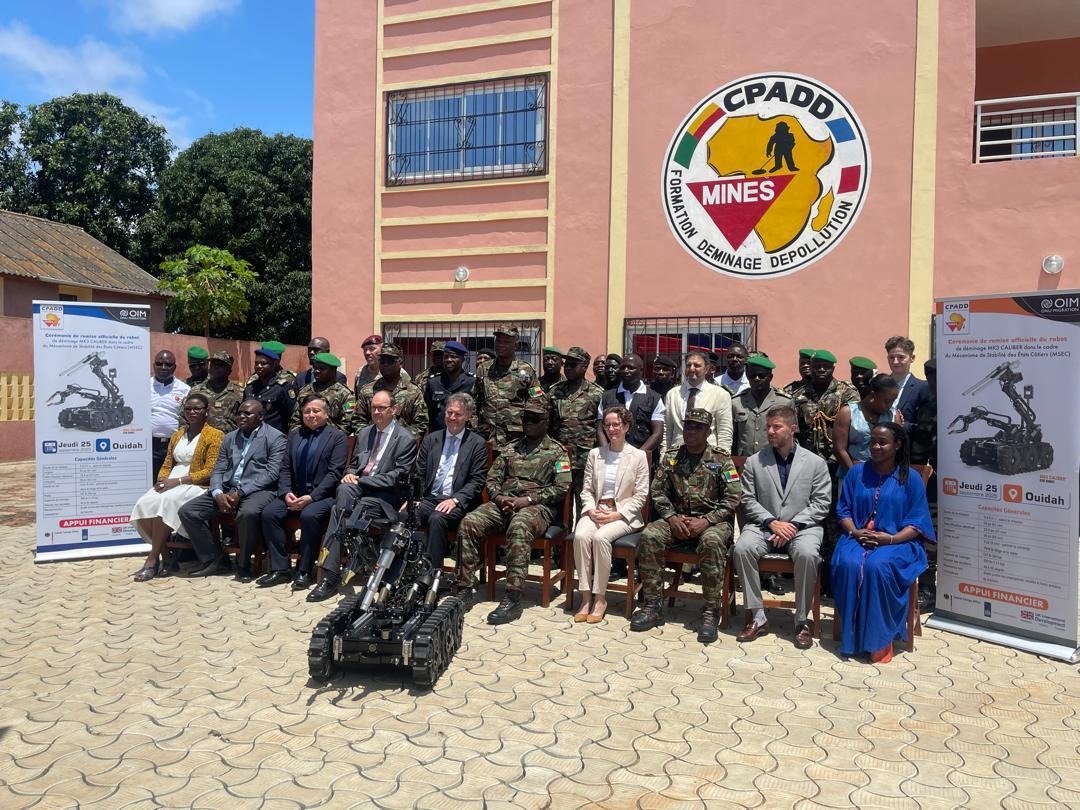
Le robot de déminage selon une publication de l'Union européenne (UE), est doté de capacités qui lui permettent de chercher, de retirer et de démonter des explosifs improvisés que les groupes armés utilisent lors des attaques. La mise à disposition de ce robot s'inscrit dans le cadre programme du Mécanisme de Stabilité des Etats Côtiers (MSEC), conjointement financé par les Pays-Bas, l'Allemagne et le Royaume Unie. En mettant le robot de déminage à disposition, les partenaires entendent d'une part, renforcer les capacités de formation du CPADD, et contribuer d'autre part, à l'amélioration de la sécurité dans les zones menacées par l'expansion des Organisations extrémistes violentes (OEVs), non seulement au Bénin mais dans tous les pays d'intervention du MSEC.
F. A. A.
Categories: Afrique, Central Europe
Voici les membres du CA du CNHU-HKM
Voici les nouveaux membres du Conseil d'Administration (CA) du Centre National Hospitalier Universitaire Hubert Koutoukou Maga (CNHU-HKM) de Cotonou. Ils ont été nommés, le 10 septembre 2025, par décret, pour un mandat de 3 ans renouvelable.
Nouveaux membres du CA du CNHU-HKM :
Enagnon Pétas AKOGBETO, représentant du Ministère de la Santé et président du Conseil d'administration.
Cyrielle AHOUANDOGBO PERROT, représentante de la Présidence de la République ;
Aristide Aboyi EDAH SOHOU, représentant du Ministère de l'Économie et des Finances ;
Ulrich Bidossessi VODOUHE, représentant du Ministère de l'Enseignement supérieur et de la Recherche scientifique ;
Victorin Vidjanagni HONVOH, représentant du Ministère du Travail et de la Fonction publique ;
Anges Paterne AMOUSSOUGA, représentant de la Mairie de Cotonou ;
Michel Armand FIOGBE, représentant de la commission médicale d'établissement.
Categories: Afrique, Central Europe
Pages
the old site is here


© 2012-2015 Europa Varietas Foundation © 2015-2020 Europa Varietas Association
www.europavarietas.org | info(@)europavarietas(dot)org | Switzerland
This is a GDPR ready site


We are looking for sponsors for the English translation of these books, please contact turkeandras(at)gmail(dot)com